September 13, 2026
Where to Place Your QR Code Room Directory in a Hotel?
Installing a QR Code in a hotel is straightforward. However, it needs to be visible in the right place at the right time. Guest room, reception, key card holder, elevator… discover the most effective locations to enhance your guests' stay.
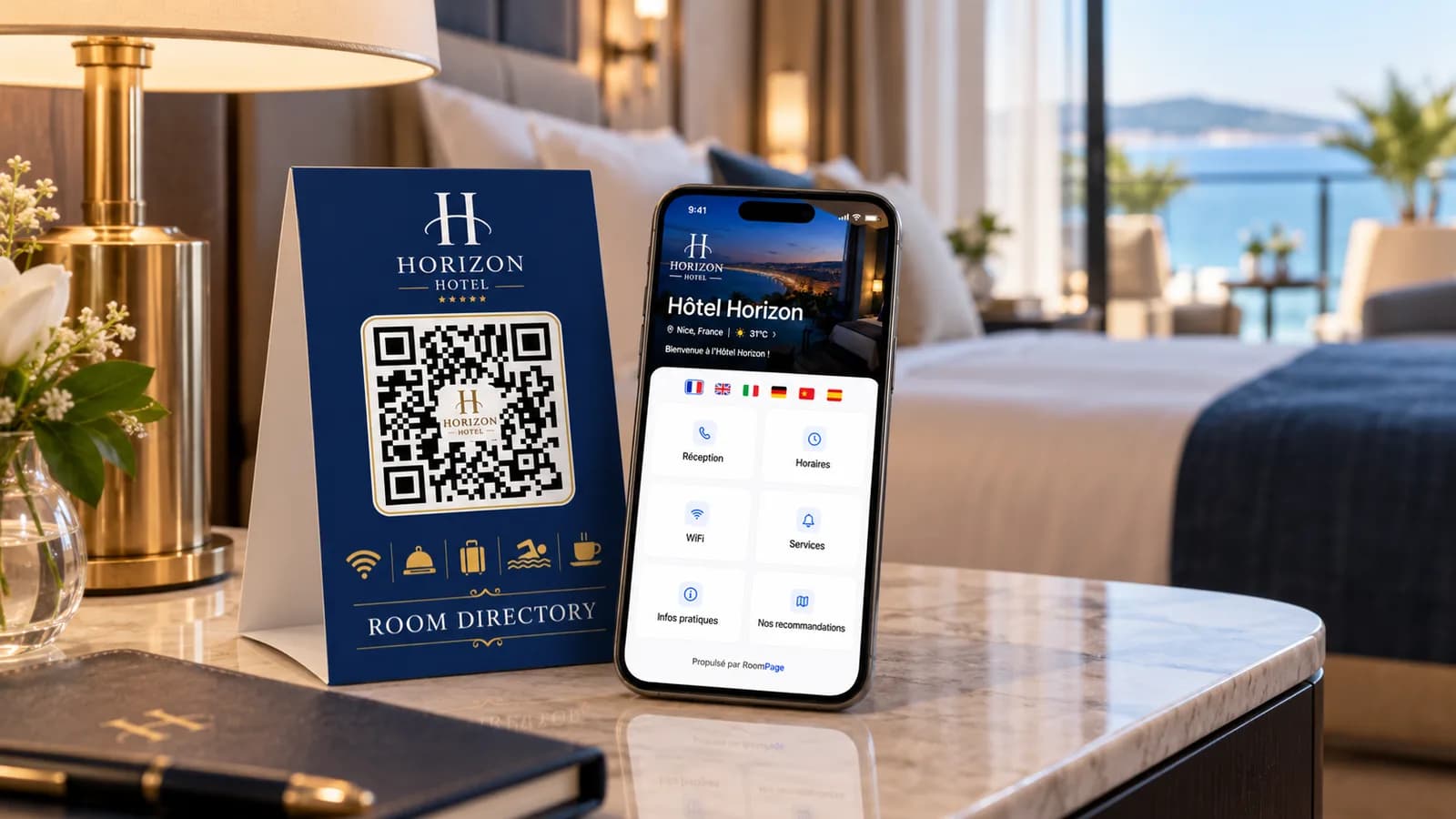
Room Directory: Where to Place Your QR Code in a Hotel?
QR Codes have gradually become standard in hotels. They now provide instant access to Wi-Fi passwords, breakfast times, available services, local recommendations, and the property's Room Directory.
However, simply printing a QR Code and placing it somewhere in the hotel isn't enough.
For a guest to think of scanning it, it must be visible when they're actually looking for information.
Here are the best locations to install a QR Code in your hotel.
1. In the Guest Room: The Essential Location
The guest room remains probably the most important place.
Once settled in, guests naturally begin searching for various information:
- What's the Wi-Fi password?
- What time is breakfast served?
- Until what time can I check out?
- Does the hotel have a restaurant?
- Where is the fitness center?
- How do I contact reception?
A QR Code placed directly in the room allows guests to get immediate answers to these questions.
It can be installed on a small stand on the desk, bedside table, or near the entrance.
The goal is simple: guests should be able to spot it without having to search for it.
2. On the Key Card Holder or Key Sleeve
The key card holder given during check-in is particularly effective.
Guests receive it immediately upon arrival and typically keep it for their entire stay.
You can add text such as:
"All information about your stay"
accompanied by the QR Code.
This gives guests permanent quick access to property information, even when they're not in their room.
3. At the Reception Desk
The reception desk is obviously an excellent location for your QR Code.
It can be placed on a small stand or holder near the counter.
It also serves an educational purpose: during check-in, your staff can simply tell guests:
"You'll find all useful information about your stay by scanning this QR Code."
Guests immediately know this resource exists and can consult it later.
This also helps reduce repetitive questions at the reception desk.
4. In the Elevator
This is often an underestimated location.
For a few seconds, your guests are stationary and their attention is available.
A small QR Code with clear messaging can catch their eye:
"Need information during your stay? Scan here."
It can provide access to schedules, services, local recommendations, or practical hotel information.
Be careful not to turn the elevator into an advertisement board: the QR Code should remain discreet and perfectly integrated with your communications.
5. In the Lobby and Common Areas
The lobby, lounges, and waiting areas are also suitable locations.
Guests may need to access information without returning to their room.
A single QR Code can give them access to all property information from their smartphone.
This is particularly useful in hotels with many amenities: pool, spa, fitness center, restaurant, parking, or coworking spaces.
6. Near Hotel Facilities and Equipment
All QR Codes don't need to be placed in the same location.
You can also place specific information directly near the relevant service.
For example:
- at the spa entrance to check schedules;
- near the pool to find usage guidelines;
- in the fitness center to display schedules or instructions;
- near parking to explain access procedures;
- at the restaurant entrance to view schedules and practical information.
Information appears exactly when guests need it.
7. On Restaurant or Bar Tables
If your hotel has a restaurant or bar, tables are also an interesting location.
The QR Code can provide access to the menu, but not just that.
It can also link to the hotel's overall digital space to showcase other available services.
A guest having breakfast might discover the existence of a spa, an activity offered by the property, or a selection of nearby attractions.
8. Before Guest Arrival
The physical QR Code isn't the only way to provide access to your Room Directory.
The link to your digital space can also be sent before arrival via email or a pre-arrival message.
Guests can then check in advance:
- the hotel address;
- parking information;
- reception hours;
- arrival procedures;
- available services;
- local recommendations.
Your digital welcome guide becomes useful before, during, and even after the stay.
Should You Place Multiple QR Codes in Your Hotel?
Yes, but in moderation.
A single QR Code hidden in a guest room risks going unnoticed.
Conversely, installing a QR Code on every wall could quickly become intrusive.
The most effective approach is to select a few strategic points in the guest journey:
before arrival → reception → guest room → common areas.
Guests can easily find access to your information without being constantly solicited.
What Should Your Hotel's QR Code Link To?
This is probably even more important than its location.
Avoid multiplying QR Codes each providing different information.
One QR Code for Wi-Fi, another for breakfast, another for parking, and yet another for activities can quickly complicate the experience.
One solution is to consolidate all information in a single digital Room Directory, accessible from a single QR Code.
Guests can then find in one place:
- Wi-Fi;
- schedules;
- breakfast;
- restaurant;
- parking;
- services;
- facilities;
- local recommendations;
- useful contacts;
- departure information.
The experience becomes much simpler.
A QR Code Should Also Be Understandable
Displaying a QR Code alone without explanation isn't always sufficient.
Add a short phrase that clearly explains what guests will get after scanning it.
For example:
"All information about your stay"
or:
"Wi-Fi, schedules, services, and recommendations"
The benefit must be immediately clear.
Consider International Guests Too
A hotel regularly welcomes guests who don't speak your local language.
QR Codes actually help avoid multiplying printed materials in different languages.
With a Room Directory offering automatic translation, each guest can access the same information in their own language from their smartphone.
This facilitates access to information while simplifying content management for the hotel.
Conclusion: Place Your QR Code Where Your Guests Actually Need It
There's no single location that works for every property.
For most hotels, three locations nevertheless form an excellent foundation:
reception, key card holder, and guest room.
You can then expand the system to common areas or near certain facilities.
The most important thing is providing a simple experience: an easily identifiable QR Code giving access to useful, up-to-date information tailored to guests' stays.
With RoomPage, hotels can centralize their information in a Room Directory accessible via QR Code and automatically translated into multiple languages, while retaining the ability to update their content at any time.