October 11, 2026
Digital Room Directory: The Complete Hotel Guide
Want to implement a digital Room Directory in your hotel? Discover our complete guide: how it works, benefits, QR codes, translations, essential information, and best practices to deliver a better experience to your guests.
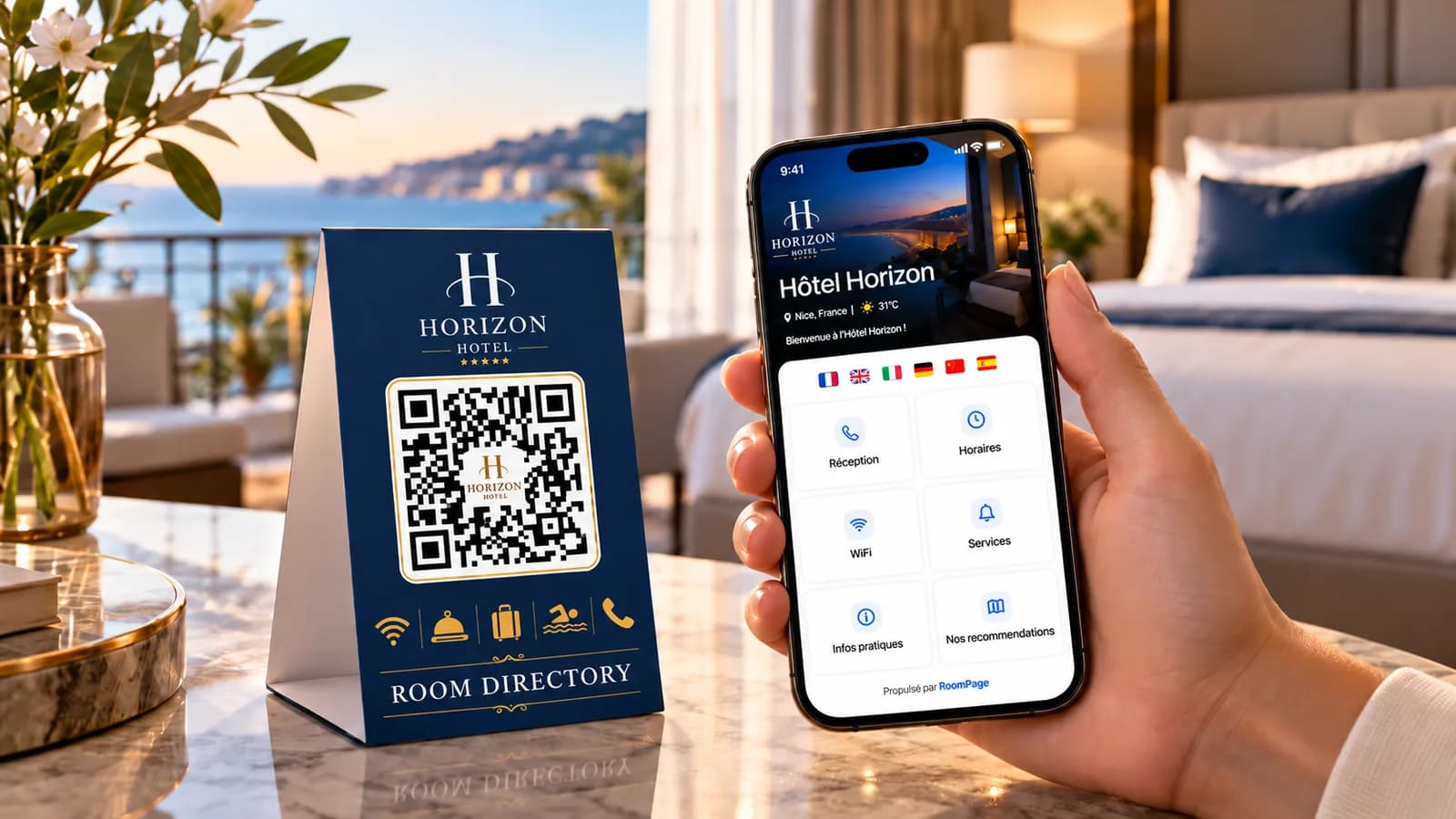
Digital Room Directory for Hotels: Complete Guide to Digitizing Guest Experience
The digital Room Directory has become an essential tool for hotels looking to modernize guest experience, better showcase their services, and simplify access to information during stays.
Wi-Fi, breakfast times, restaurant, spa, parking, room amenities, local recommendations, and practical information can now be consolidated in a single space accessible directly from a traveler's smartphone.
With a simple QR Code in the hotel room, guests instantly access all useful information without downloading an app or repeatedly contacting the front desk.
But what exactly is a Room Directory? What are its benefits for a hotel? What should you include? And how do you choose a solution suited to your establishment?
Here's the complete guide to digital Room Directory for hotels.
What is a Room Directory?
A Room Directory is a guide containing all useful information a guest might need during their hotel stay.
You'll also find these terms:
- digital welcome guide
- digital welcome booklet
- Guest Directory
- digital information guide
- digital room directory
For a long time, this information was compiled in a binder or paper booklet placed in each room.
The digital Room Directory follows the same principle, but in an interface specially designed for smartphones.
Guests simply scan a QR Code placed in their room, at reception, or throughout the hotel to instantly access information.
This solution allows hotels to update content anytime without reprinting documentation.
Why Replace Your Hotel's Paper Welcome Booklet?
The paper booklet was long the simplest solution for transmitting establishment information.
But it has several significant limitations.
1. Information becomes outdated quickly
In a hotel, information evolves regularly.
Breakfast times change.
New services appear.
Spa rates fluctuate.
A partner restaurant closes.
A phone number needs updating.
With paper, every change means reprinting some or all booklets in guest rooms.
With a digital welcome guide, information can be updated directly from an admin interface.
2. Recurring printing costs
A hotel with dozens of rooms may need to print as many booklets as rooms.
Add to this:
- reprints
- rate changes
- schedule updates
- new services
- versions in different languages
A digital Room Directory lets you keep the same QR Code while evolving content over time.
3. Travelers now accustomed to smartphones
When guests need a Wi-Fi password, breakfast times, or a restaurant address, their first instinct is usually to use their phone.
A hotel QR Code makes information instantly accessible on a device guests already have.
No need to download an app or create an account.
4. Better language management
Hotels regularly welcome international clientele.
Creating multiple paper versions of a Room Directory quickly becomes complex.
A digital solution makes sharing information in multiple languages much easier.
On RoomPage, for example, Room Directory content can be offered automatically in multiple languages so travelers can access information more easily, regardless of nationality.
What Are the Benefits of a Digital Room Directory?
A Room Directory doesn't just replace a paper booklet.
When used properly, it becomes a true tool for improving guest experience in the hotel.
1. Travelers find information immediately
No need to search for a binder in the room or call reception.
Guests scan the QR Code and instantly access:
- Wi-Fi
- schedules
- services
- amenities
- practical information
- local recommendations
2. Reception gets fewer repetitive questions
Certain questions come up daily in hotels:
"What time is breakfast?"
"What's the Wi-Fi password?"
"Until what time is the pool open?"
"Where can we park?"
"How does the air conditioning work?"
Centralizing these answers helps travelers become more independent.
Staff can spend more time on check-in and requests requiring their intervention.
3. The hotel can better showcase its services
This is also one of the most important benefits of a modern Room Directory.
Guests may not know all services offered by the establishment.
The Room Directory can clearly present:
- breakfast
- restaurant
- bar
- spa
- massages
- room service
- laundry
- parking
- late check-out
- additional activities or services
A better-visibility service naturally has better chances of being discovered by guests.
The Room Directory becomes a true digital touchpoint between the hotel and traveler.
4. Information remains accessible 24/7
Even when reception is closed or busy, guests retain access to all important information.
The Room Directory can be consulted anytime from a traveler's smartphone.
What to Include in a Hotel Room Directory?
A good Room Directory should answer the main questions guests might have before and during their stay.
Here are the most useful categories.
Hotel practical information
You can include:
- check-in times
- check-out times
- reception contact details
- luggage storage
- Wi-Fi
- parking
- hotel access
- available services
- house rules
- specific guidelines
Room information
The Room Directory can explain how amenities in the room work.
For example:
- air conditioning
- heating
- safe
- television
- coffee maker
- minibar
- electric blinds
- telephone
- specific equipment
Simple explanations can prevent many reception requests.
Highlight Hotel Services
The Room Directory can also serve as a showcase for various services available at the establishment.
For example:
Breakfast
Indicate times, location, price, and any different packages offered.
Restaurant & Bar
Present opening hours, key information, and the restaurant menu.
With a solution like RoomPage, you can integrate restaurant or bar menus as PDFs directly into the Room Directory.
Spa and wellness
Present:
- hours
- treatments
- prices
- booking procedures
Pool
Indicate hours, access rules, and any safety information.
Late check-out
If your establishment offers paid late checkout, the Room Directory is an excellent place to inform travelers of this option.
Add Local Recommendations Around the Hotel
A Room Directory can also become a true local tourism guide.
The hotel can recommend favorite local spots:
- restaurants
- museums
- activities
- walks
- tourist attractions
- transportation
- parking
- pharmacies
- shops
- beaches
- local events
This extends guest experience beyond the establishment.
Hotel recommendations are typically more relevant than generic searches, as they reflect the team's local knowledge.
Why Use a QR Code in a Hotel?
The QR Code is particularly suited to Room Directory as it provides access to a webpage in seconds.
The process is very simple:
- the traveler opens their smartphone camera
- they scan the QR Code
- the Room Directory opens directly in their browser
No app is necessary.
The same QR Code continues to work even when Room Directory content is updated.
Where to Place the Room Directory QR Code in a Hotel?
QR Code placement significantly influences its use.
It must be visible when guests are likely to need information.
The most interesting locations include:
- on the room desk
- on the bedside table
- near the phone
- near the television
- on a dedicated sign
- at reception
- in the elevator
- near the spa
- in the pool area
- at the bar
- in the restaurant
You can also send the Room Directory link before guest arrival.
Travelers can start exploring establishment services before entering their room.
Physical QR Code or QR Code Displayed on TV?
Some hotels consider displaying the QR Code directly on the room television.
This method can work, but it has certain limitations.
A QR Code displayed on television:
- is only visible when TV is in use
- may disappear when guests change screens
- depends on the TV system installed in the hotel
- sometimes requires specific technical integration
- can result in higher installation costs
By contrast, a physical QR Code remains visible throughout the stay and can be placed in multiple locations.
For most hotels, the physical QR Code remains the simplest solution to deploy.
Should a Room Directory Be Translated?
For establishments welcoming international clientele, translation is particularly important.
A guest who easily understands hotel information is naturally more independent.
This helps limit:
- misunderstandings
- errors about schedules
- questions about equipment operation
- service difficulties
Translation also improves overall Room Directory accessibility.
RoomPage, for example, offers automatic Room Directory translation into multiple languages, allowing establishments to avoid managing multiple versions of their information manually.
Why a Simple PDF Isn't Always Enough?
A PDF can be useful for certain information, like a restaurant or bar menu.
But using only a PDF as a Room Directory has several limitations.
On smartphones, you often need to:
- zoom in
- scroll through long pages
- manually search for information
- go back frequently
A true Room Directory must be designed specifically for mobile consultation.
Users should navigate quickly between categories.
Buttons must be easily accessible.
Phone numbers should be directly callable.
Links should be clickable.
Addresses should open in mapping applications.
The Room Directory becomes much more pleasant to use than a simple scanned document.
What Features to Look For in a Room Directory?
Before choosing a solution, several elements should be verified.
1. An interface adapted for smartphones
Most consultations will occur from a phone.
Display must be perfectly optimized for small screens.
2. Simple updates
Changing a schedule or adding information should take just minutes.
3. Translation
Being able to offer information in multiple languages is a major advantage for tourism establishments.
4. Customization in hotel colors
The Room Directory should ideally reflect the establishment's visual identity.
This can involve:
- logo
- colors
- photos
- various services
5. Interactive links
Phone, directions, booking, or website: actions should be accessible with a few clicks.
6. Consultation statistics
Statistics help you understand if travelers actually use the Room Directory and which information is consulted.
This can also help the establishment gradually improve its content.
RoomPage: A Room Directory Designed for Hotels
RoomPage is a digital Room Directory solution designed for hotels and tourism accommodations.
The goal is to simply centralize all information useful for stays in one page accessible via QR Code.
The establishment can present:
- practical information
- Wi-Fi
- schedules for various services
- amenities
- bar
- restaurant
- spa
- local recommendations
- PDF documents and maps
- useful links
- tourism information
The Room Directory is optimized for smartphones and requires no app.
RoomPage also allows establishments to customize their space according to needs and modify information as needed.
Hotels also get advanced consultation statistics to better understand Room Directory usage.
The goal isn't just to replace the paper booklet, but to create a true digital information point available throughout the stay.
How Much Does a Digital Room Directory Cost?
Room Directory pricing varies based on several factors:
- number of rooms
- available features
- customization level
- languages offered
- statistics
- number of managed properties
Most solutions operate on annual subscription.
It's important to compare not just price, but especially features truly useful to your establishment.
A small independent hotel won't necessarily have the same needs as an establishment with hundreds of rooms.
Room Directory and Guest Experience: A New Communication Tool for Hotels
Digitalizing a hotel doesn't necessarily mean replacing human contact.
Quite the opposite.
A Room Directory's goal is to let travelers instantly find simple information so teams can spend more time on exchanges that truly add value.
Repetitive requests can be automated.
Personalized advice remains human.
This complementarity makes the Room Directory particularly interesting.
Conclusion: Should You Switch to Digital Room Directory?
The digital Room Directory isn't simply a digital version of the old welcome booklet.
It's progressively becoming a true communication tool between hotel and guests.
Accessible through a simple QR Code, it centralizes information, makes travelers more independent, better showcases establishment services, and simplifies certain reception tasks.
For hotels wanting to modernize communication without imposing a new app on guests, it represents a particularly simple solution to implement.
With a solution like RoomPage, the establishment can centralize content, modify it easily, offer it in multiple languages, and better highlight services provided during stays.
The goal remains simple: help guests find the right information, at the right time, directly from their smartphone.